

By Jon Perring
25th November 2026
The NSW experience
The O’Farrell Liberal NSW Government and its conservative successors did a lot to destroy Sydney’s live music culture over an extended period. The 2014 lockouts of licensed venues sent many venues to the wall and also created a culture among police and regulators that live music venues were the problem. Live Music audiences and band numbers dwindled as a result. On top of this, after a small number of tragic drug overdose deaths at a couple of festivals in 2018, the Berejiklian Liberal Government controversially instituted strip searches, refused pill testing and instituted a user-pay policy for mandatory policing at music festivals, inflicting further injury and insult to the NSW Live Music Industry.
In March 2023, the NSW Government changed flavour to Labor. Chris Minns became Premier and, importantly, for the first time, a Government Minister, John Graham, assumed direct responsibility for Live Music. He was also responsible for the Arts and the Night-time Economy. These portfolios synced in with his other responsibility as Minister for Jobs and Tourism. Arts, which included Music, were no longer seen as a standalone ministry with only funding responsibilities, but as an important industry segment requiring specific Government attention within the broader Creative Industries.
Graham responded to the voice of the music community and industry and, after the 2023 election, shepherded three Acts of Parliament into law (the Vibrancy Reforms legislation of 2023, 2024 and 2025) in response to the cultural damage inflicted by the previous Liberal Governments.
Special mention should be given to John Wardle, formerly of the Live Music Office, for his recognised role in architecting many of these reforms and in building political consensus across government, opposition, and crossbench to all vote to pass the Liquor Amendment (24-hour Economy) Act 2020 where the omnibus reform vision was passed into law under the previous Coalition government in 2020. It was John Wardle’s vision tabled initially through a Live Music Office submission[1] in February 2018 and then, consequential evidence to a series of NSW Parliamentary inquiries, which guided the roadmap NSW has today and which laid out the coordinated rationale for a Minister for Music, a night-time economy commissioner within government, a state music development office, the introduction of Special Entertainment Precincts. It also removed outdated entertainment conditions, late trading and fee incentives for live music venues, exempt development and small arts venues in the planning approvals pathway, and more[2].
Liquor Amendment (24-hour Economy) Act 2020[3]: Initially pushed heavily during his time as Shadow Minister, Graham and Wardle successfully negotiated amendments that stripped away archaic regulations (such as genre bans and restrictions on venue staging) while securing licensing discounts for live music venues. This Act also went further by amending both the Building Code of Australia and the Standard Instrument (Local Environmental Plans) Order to remove antiquated and socially biased restrictions on Live Music.
The main reforms are:
· Includes in the Objects of the Act: “the need to support employment and other opportunities in the live music industry, and arts, tourism, community and cultural sectors.
· Expands the definition of a dedicated Live Music and Performance Venue that “are a music hall, concert hall, dance hall or other space used primarily for the purpose of live music, live performances or creative or other cultural uses and are licensed under an on-premises licence for a public entertainment venue, or are used to host live music as part of the Great Southern Nights music event”.
· Amends the Building Code of Australia to include a definition of a Small Live Music or Arts Venue to mean:
- the whole or part of a Class 6 building that has a rise in storeys of no more than 2 floors in which live music or arts are provided to the public, and that has a floor area of not more than 300 square metres. This avoids the onerous and exceedingly expensive need for major building works and upgrades for spaces used for small performances.
· Amends the Standard Instrument (Local Environmental Plans) Order 2006 so that:
- Standards that cannot be used to refuse planning consent—playing and performing music [compulsory]
- The consent authority must not refuse consent to development in relation to licensed premises on the following grounds - the playing or performance of music, including the following:
· the genre of music played or performed,
· whether the music played or performed is live or amplified,
· whether the music played or performed is original music,
· the number of musicians or live entertainment acts playing or performing,
· the type of instruments played,
· whether dancing occurs,
· the presence or use of a dance floor or another area ordinarily used for dancing,
· the direction in which a stage for players or performers faces, and
· the decorations to be used, including, for example, mirror balls, or lighting used by players or performers.
· The consent authority must not refuse consent to development in relation to licensed premises on the grounds of noise caused by the playing or performance of music, if the consent authority is satisfied the noise may be managed and minimised to an acceptable level.
· Removal of live entertainment condition on all liquor licences except where the condition relates to adult entertainment of a sexual nature and disallowing any reimposition of live entertainment conditions.
· Certain live entertainment liquor licence conditions cease to have effect that:
- restricts the genre of music that may be played or performed on the licensed premises,
- restricts the number of musicians or live entertainment acts that may perform on the licensed premises,
- restricts what type of instruments may be played on the licensed premises
- restricts the performance of original music
- restricts a stage for live performers from facing a particular direction
- restricts decorations, including, for example, mirror balls, or lighting used by musicians,
- prohibits live music, live entertainment or the amplification of a musical instrument at all times or across the entire licensed premises,
- a condition that prohibits or restricts the presence or use of a dance floor or another area ordinarily used for dancing
The Act also provides that:
· A licensee is exempt from the requirement to pay a fee in relation to an application to vary or revoke a prescribed live music condition that applies to the licensee’s licence.
· The provisions about disturbance complaints in the Act do not apply to a complaint in relation to noise that is emitted wholly from within licensed premises.
· Reduction of liquor licence fees for live music venues by 80%.
· Extension of trading hours by 30 minutes for dedicated live music and performance venues located in the City of Sydney or a special entertainment precinct when a live music performance or other arts and cultural event of at least 45 minutes duration is held after 8 pm.
· Develop further licensing incentives to encourage licensed premises to program live entertainment including events at which one or more persons are engaged to play, perform live or pre-recorded music, and performances at which the performers, or some of the performers, are present in person.
Creative Statement to Parliament Act 2025[4]: Enacted in early 2025 under his carriage as the Minister for the Arts, setting up structural support framework commitments for the state’s cultural sectors.
This involved the Minister preparing a 3-yearly Creative Statement to the Parliament that outlines “the status, health and progress of the creative industries in New South Wales and progress in implementing the Government’s policies and plans in relation to the creative industries.” This includes “direct support provided by the Government to First Nations creative industries, and activities undertaken by the Government to improve the participation of First Nations people in the creative industries”.
The sector is defined as:
Arts and Culture
· performing arts, including cabaret, circus, comedy, dance, drama, music and theatre,
· visual arts and crafts, including drawing, mixed media, painting, photography, printing and sculpture,
· music, including classical and contemporary composition, performance and recording,
· literature, including fiction, non-fiction, poetry and prose, published in books, newspapers and magazines, whether print or digital,
· media arts, including broadcasting, news, radio and screen and digital games.
Creative Industries includes the following:
· the arts and culture sector,
· the First Nations culture sector,
· the cultural institutions sector, including archives, galleries, libraries and museums,
· the architecture, design and fashion sector,
· the built and physical heritage sector,
· the arts and culture education sector,
· creativity in the food and beverage sector,
· creative innovation in the technology sector, and
· another sector or industry prescribed by the regulations.
Contemporary Music Act 2026[5]: Passed in September 2026, this landmark, “world-first” law was spearheaded by Graham to protect and revive the state’s live music sector. The Act establishes a venue accreditation scheme that recognises dedicated live music venues, significant live music venues and live music venues; prohibits decision-makers, including councils and government agencies, from making decisions about live music events solely on the basis of music genre; adjusts concert rules so small multi-act events aren’t over-regulated as large-scale festivals; and lists supporting human creativity in contemporary music among its objects.
Factors such as music genre, the number of people in a band, instrumentation controls, production restrictions, and venue decorations serve as proxies for class, ageism, and subcultural and ethno-cultural (race) control. Such concepts have no basis for codification in law, as they would breach Australia’s human rights obligations. Appropriate controls include environmental sound threshold controls; behaviour thresholds in the Liquor Act; urban planning to ensure that residential and other sensitive uses are built to protect occupants from cultural sounds (as well as other anthropogenic sounds); and sensible risk thresholds that are scaled to event sizes and their plans through balanced permit conditions.
In NSW, the Police and regulators have consistently failed to understand that such a balance is needed, so reform of State Government regulations has long been overdue.
The Office of the 24-Hour Economy Commissioner
The Office of the 24-Hour Economy Commissioner traces back to a 2018 NSW Parliamentary Inquiry into the Music and Arts Economy[6], which recommended a dedicated government body to coordinate night-time economy policy and lobby for, by the music industry.
The first 24-Hour Economy Strategy, published by the NSW Government in 2020, established the Office to revive the sector from over-regulation and a lack of government coordination. Michael Rodrigues, formerly of Time Out Australia, who chaired the Night Time Industries Association (alongside Keep Sydney Open, Unlock-Sydney, Reclaim the Streets, the Australian Hotels Association and The Australian Greens that campaigned to overturn Sydney’s 2014 lockout laws) was appointed as the state’s first 24-Hour Economy Commissioner in April 2021.
In 2023, the NSW Parliament passed the 24-Hour Economy Commissioner Act 2023[7], making the role a permanent statutory appointment and also, expanding the Office’s remit from Greater Sydney to all of NSW.
The Office of the 24-Hour Economy Commissioner’s Vibrancy Reforms[8] were built around six areas: sensible venue sound management, vibrant coordinated precincts, an activated outdoors, empowering the Commissioner, licensing reform, and improving conditions for night-time workers.
The first tranche of Graham’s legislation, the 24-Hour Economy Legislation Amendment (Vibrancy Reforms) Act 2023[9], ended the practice of single noise complaints shutting down licensed venues. From 1 July 2024, Liquor & Gaming NSW became the lead regulator for entertainment sound from licensed venues, and complaints must now come from five separate households rather than three.
In 2024, a refreshed second 24-Hour Economy Strategy[10] was published, and the role expanded to include a regional focus (e.g., Wollongong, Newcastle). A second tranche of reforms was enacted as the 24-Hour Economy Legislation Amendment (Vibrancy Reforms) Act 2024.[11] A related planning bill — the Environmental Planning and Assessment Amendment (Vibrancy Reforms) Bill 2024[12], approved by Cabinet — introduced “Vibrancy Guidelines” that councils must weigh when assessing extended-trading applications for venues 500m+ from residential property, developed jointly with the Commissioner.
In November 2025, Parliament passed the 24-Hour Economy Legislation Amendment (Vibrancy Reforms) Act 2025.[13] This further round of consequential Vibrancy reforms (each building on the omnibus Liquor Amendment (24-hour Economy) Act 2020) created a pathway for disputes involving significant live music venues to be referred to mediation, streamlined planning approvals for live entertainment (the Cultural SEPP) and let venues expand outdoor capacity more easily, including regional “farmgate” venues. This culminated on 21 January 2026 — twelve years to the day after the lockout laws were announced — in the removal of the final major lockout provisions, including the 3:30 am “last drinks” rule, across Kings Cross, Oxford Street and the CBD. By then, Special Entertainment Precinct trials were under way in areas like Fairfield, Rozelle and Marrickville, following the success of the Enmore Road Special Entertainment Precinct.
The Victorian experience
Victoria’s law reform followed a very different path because the history of the friction between the Victorian Government and the Music Industry was radically different.
In 2008, the Brumby Labor Government introduced a “2am Lockout”, designed to curb alcohol-related violence in Melbourne’s CBD and inner suburbs, including Carlton, Fitzroy/Collingwood, Richmond, Prahran/South Yarra and St Kilda. This was largely in reaction to an editorial campaign run by the Herald Sun in reaction to “alcohol-fuelled violence”. It was announced by Premier John Brumby on 2 May 2008 and ran as a three-month trial from June to September 2008, during which patrons couldn’t enter (or re-enter) venues between 2 am and 7 am.
This was challenged by 46 Venues at VCAT, who successfully obtained exemptions from the lockout, in part by arguing that the first weekend of the lockout actually saw a rise in violence rather than a fall.
The Premier John Brumby, facing public dissatisfaction and overwhelming evidence the lockout wasn’t working, killed the laws off, saying “we’ve decided as government we will not be continuing with a permanent lockout.”[14] Post-trial surveys, including a report by KPMG[15] of venues and patrons, found the lockout had had little or no effect. This is backed up by the Police’s own crime statistics.
The Melbourne experience is frequently cited (including by Sydney’s own lockout critics) as a cautionary tale. The NSW Government ignored the Victorian experience and introduced its own, much longer-running lockout laws in 2014.
The Victorian Government shifted tactics
In 2008, the Victorian Government froze the granting of new liquor licences in inner-city Melbourne. Originally meant to be temporary, the freeze has been repeatedly extended and has effectively persisted for over 15 years, restricting any new venue from operating past 1 am in the frozen zone.[16] The freeze was tested at VCAT but remained.
Interestingly, the Carroll Labor Government has promised that, if re-elected in November 2026, every pub in Victoria will have an automatic right to trade to 3am, while the Liberal-National Coalition opposition has promised to cut red tape and expedite liquor licence 3 am extension approvals. Both positions indicate that the initial liquor licence freeze policy was not evidence-based but instituted for popularist, politically pragmatic reasons at the time.
In 2009, through the then Liquor Licensing Commissioner Sue Maclellan, live music was inappropriately linked to violence, classifying music venues as “high-risk” and imposing extra security conditions on Liquor Licences that had “live or amplified music” and traded past 1 am. More importantly, these conditions were already on many existing liquor licences, and the licensing laws were, by and large, not enforced. That suddenly changed, leading to the closure of the iconic Tote Hotel, the spiritual home of Australian Rock’n’Roll, and threatening many other small venues. Suddenly, gigs were drying up all over town, from Greek restaurants to laid-back Sunday-afternoon sections. Live Music gigs became unviable to stage by many licensed live music venues.
The closure of the Tote sparked a small but impactful protest of 4,000 punters and live music fans (the “Tote rally”), spontaneously closing off the corner of Johnston and Wellington St, Collingwood, for a night.
Concerns about the direction of government policy led to the re-formation of Fair Go 4 Live Music (led by me), an informal collective aiming to protect Victoria’s contemporary live music scene. After the Tote Rally, SLAM (Save Live Australia’s Music spearheaded by Helen Marcou and Quincy McLean) began organising a larger rally of 20,000 held on the 23 February 2010 on the Victorian Parliament’s steps. Both organisations met jointly to formulate a unified music industry policy position, which ultimately led to the Live Music Accord with the Victorian State Government.[17]
Parallel to these events, Music Victoria was established as a contemporary music industry peak body and was ultimately funded by the state government in early 2010 as a direct result of these protests.
The Live Music Accord[18] committed the Victorian Government to no new or additional security restrictions being imposed on venues playing live music or licensed to trade after 1 am, that “high-risk” crowd-controller conditions would only be enforced when deemed necessary, and that new liquor licensing restrictions applied over the preceding 12 months would be revoked. This was followed by roughly seven months of negotiation that produced the Live Music Agreement, in which the government officially acknowledged that “live music does not cause violence”.
The Live Music Accord was co-signed by the Victorian Government, FG4LM (Fair Go 4 Live Music), SLAM and Music Victoria on the eve of the 23 February 2010 rally. It followed direct talks, including a meeting between Premier John Brumby and live music industry representatives, with Consumer Affairs Minister Tony Robinson leading negotiations. It established key principles in the form of commitments by the State Government.
· No new or additional security restrictions would be imposed on venues playing live music or licensed to trade after 1 am.
· “High-risk” security conditions (i.e., mandatory crowd controllers) would only be enforced when actually deemed necessary, rather than automatically.
· New liquor licensing restrictions applied over the preceding 12 months would be revoked.
· Individual venues were given more discretion to organise their own security, and crowd-control conditions would not be automatically applied to new live music venues unless mandated by planning approval, breach of liquor licence conditions, or specific police recommendation.
· The Accord formally acknowledged live music as an “inclusive, community-based culture” that should be protected, and officially recognised live music’s “significant contribution to the cultural wellbeing of Victorians” and its “significant economic contribution to Victoria”. This represented a deliberate policy shift in the framing of live music away from violence/disorder toward cultural and economic value.
The Accord was followed by The Live Music Agreement[19] (signed on 6 October 2010), which detailed the regulatory mechanics to be worked out, translating the Accord’s principles into a concrete regulatory process, reached roughly seven months later.
Key promises/commitments:
1. It established a “common sense approach” to imposing crowd controller conditions on live music venues — ending the blanket/automatic high-risk classification.
2. Live music venues that already had crowd controller conditions on their licence could apply to have those conditions varied or removed, and crucially, this variation application was made free of charge — there was “no fee to apply to vary your licence conditions as a live music venue.”
3. This created an ongoing regulatory distinction: venues granted a liquor licence before 6 October 2010 kept their existing crowd-controller conditions unless they applied to vary them, while the “common sense” assessment approach applied going forward.
4. Live Music Agreement officially proclaimed that live music does not cause violence.
Shortly after, the Liquor Control Reform Act 1998[20] was amended to include in its objects the recognition of the importance of live music, following the NSW Liquor Act objects from 2007.
As a side note, this led to Andy Portokallis, Sam Crupi, and myself reopening the Tote in 2010. However, that’s another story for another day.
After the Victorian Liberal-National Coalition took Government in November 2010, it established the Victorian Live Music Round Table, of which I was a founding member. It was a unique initiative to create a forum for various government departments to interact with the music industry (particularly live performance), creating a whole-of-government relationship with key music industry stakeholders.
Both Tony Robinson (Minister for Consumer Affairs) and Rob Hudson (Parliamentary Secretary to the Premier: National Reform, Arts, Public Service) the ministers involved in the Live Music Accord negotiations, lost their seats at the 2010 election.
Its terms of reference can be found here. https://livemusicoffice.com.au/wp-content/uploads/2015/08/Victorian-Live-Music-Roundtable-Terms-of-Reference.pdf
The Victorian Live Music Round Table was responsible for persuading the Victorian Government to enshrine the Agent of Change principle in planning laws. This principle, “the onus of responsibility for the cost of noise management should fall upon the ”agent of change”’[21] was developed and defined in 2003 by the Victorian Live Music Taskforce (I was also a member) in its final report but never implemented into law. The Agent of Change was formally implemented on 4 September 2014, signed into law by Planning Minister Matthew Guy (Liberal), making developers of new residential buildings within 50m of existing live music venues responsible for the cost of soundproofing, so established venues couldn’t be forced to bear the substantial cost of soundproofing from noise complaints from their new neighbours.[22]
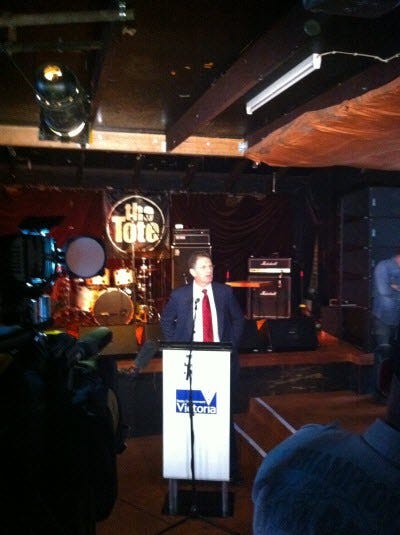
Liberal Premier Ted Baillieu in 2011 delivering his message at The Tote that
“Liberals Love Live Music”.
The Agent of Change principle as implemented in the Victorian Planning Provisions (53.06 LIVE MUSIC ENTERTAINMENT VENUES) directly saved several venues, including the Gasometer Hotel, Howler, The Tote and Whole Lotta Love.
Other achievements included reforms of underage and all-ages gig licensing. However, the Live Music Roundtable lapsed in March 2020 at the beginning of the COVID lockdown when it was most needed as Melbourne faced the world’s longest lockdown of 262 days spanning 31 March 2020 to 21 October 2021 in 6 lockdown periods.
In 2020, the concept of Live Music Precincts was introduced in the Victorian Planning Scheme (53.06); however, no Live Music Precincts were defined aside from the Victorian Government’s Collingwood Yards, which houses a number of arts organisations (3PBS, Music Victoria, The Victorian Music Development Office, Circus Oz, etc.). A Live Music Precinct requires soundproofing to be added to any residential development or similar sensitive use within a Live Music Precinct to protect occupants from Unreasonable Sound as defined in the Victorian Environmental Noise Regulations. Recently, on 26 October 2026, a planning overlay has been added to the Victorian Planning Scheme (45.13 Live Music Overlay) that allows for a more detailed graphical representation to define Live Music Precincts; however, even after six years of the concept being introduced into the Victorian Planning Provisions, one has yet to be implemented.
Key differences
The key difference between the Victorian and NSW journey to protect and normalise the regulation of Live Music boils down to several factors:
Victoria won its battle against lockout laws early on, whereas NSW lost. The cultural and $16 billion of economic damage[23] in NSW was significantly greater than in Victoria, warranting a depth of policy response appropriate to the damage. Certainly, the NSW government was politically blinkered and ignored the Victorian lockout experience, resulting in the unnecessary damage.
Victoria early on established the Victoria Live Music Round Table, which established the Agent of Change planning protection for Live Music Venues by the then Liberal National Coalition Government after seeing what a political force the Live Music Community could be when it got its tail up.
However, after Labor won Government again in 2014, its interest in Live Music Policy shifted from a reform agenda to arts funding through the new Creative Industries-focused Department - Creative Victoria, resulting in a loss of reform momentum and the ultimate dissolution of the Live Music Round Table in March 2020 under cover of the pandemic emergency. This left unfinished reform business that still requires attention today. Coming out of the pandemic, Creative Victoria focused on identity politics-driven grants as an economic response to the COVID lockdowns rather than conducting a strategic audit and a considered policy response to the COVID lockdown damage done to live music’s institutions (festivals, venues and rehearsal studios), its bands, musicians, and its audiences. The discontinuing of the Victorian Live Music Roundtable, which aligned with significant steps in music policy, particularly in NSW, ACT, and WA, left Victoria disconnected from national policy development in a time of significant and positive change.
Victoria is still grappling with this landscape and how to respond to it. Creative State 2028 is Creative Victoria’s strategic framework guiding the growth, investment, and future of Victoria’s cultural sector. Its plan for the Music Industry is to “develop a contemporary music strategy in partnership with the Victorian Music Industry Advisory Council to leverage and enhance Melbourne and Victoria’s position as a global music destination and exporter”. In other words, the Victorian Government’s strategic plan is to write a plan.
Lessons for Victoria
Victorian policy advocates can learn a lot from what NSW has achieved. In particular, advocating that the Victorian Government adopts a similar set of relevant guidelines and principles as per the NSW Liquor Amendment (24-hour Economy) Act 2020 and consequential Vibrancy Reforms (note, I’ve used Victorian terms like “Live Music Precincts” instead of “Special Entertainment Precincts” to avoid confusion).
1. Removing Red Tape and Outdated Restrictions by simplifying complex planning and licensing laws that previously strangled local creativity.
- Streamlined Approvals for events, festivals, and outdoor dining by introducing more exempt or complying pathways.
- Switching Off Bad Rules: Automatically disabling legacy liquor licence conditions that banned specific music genres, acoustic instruments, or mandatory closed-door rules for live indoor performances.
2. Fairer “Sensible Sound” Management: Establishing balanced, single-agency sound regulation, preventing multiple overlapping government bodies from policing the same issue.
- Introduce Higher Complaint Thresholds by raising the minimum requirement from 3 to 5 independent households before a statutory noise disturbance investigation is triggered.
- “Eyes Wide Open” Disclosures. Forcing Contract of Sale Section 32 in late-night zones to explicitly state that the area is an active Live Music Precinct, protecting venues from unexpected neighbourhood friction.
3. Incentivising Live Music and Cultural Activation rather than just penalising compliance breaches, the policy shifts toward actively rewarding venues that contribute to local culture:
- Extended Trading: Offering an automatic extra two hours of late-night trading for venues showcasing compliant live entertainment.
- Financial Breaks: Providing an 80% discount on annual liquor licence fees for dedicated live music spaces.
4. Activating the Outdoors and Creating Coordinated Precincts. The reforms prioritise using public spaces dynamically to bring people together in open, communal spaces rather than forcing them to retreat indoors.
- Live Music Precincts (LMPs): Empowering local councils to designate specific areas with tailored noise rules, relaxed trading frameworks, and coordinated local programming.
- Permanent Outdoor Dining: Making it easier for sidewalks and public areas to be utilised permanently for dining and performance.
5. Practical, People-Centric Harm Reduction. A core pillar of the strategy is maintaining safety without imposing draconian locks. Reform laws to aim to support vulnerable patrons by shifting to welfare-focused intoxication management. NSW venues now have the option to safely retain and monitor vulnerable or overly intoxicated patrons on-premises for medical care or safe transport, rather than immediately ejecting them onto the streets where they face higher risks.
The Victorian Government needs to move to adopt such principles and codify in an Act of Parliament how governments can and can’t regulate Live Music through permissions and permit conditions on liquor licences, planning or other permits issued by state and local governments by setting the boundaries of the law so class, race, culture and gender policy proxies such as music genres, number of players, decoration types, types of lighting, the type of musical instruments used, or whether instruments are acoustic, electric or amplified, and “no dancing” edicts are not factors to be proscribed.
Existing planning permits and liquor licences should have inappropriate conditions unilaterally invalidated, such as “no live music”, stage positions, “no dancing”, “patrons must be seated” or any of the above proxy edicts.
Accepting the ideology of Creative Industries is not necessarily the best way for a government to manage live music. Although it is widely accepted that the music scene is an industry and sees itself as such, a large proportion of its live music activity is driven by a desire for people to participate in music-making. The economics of the DIY scene simply aren’t functional. This means that at the DIY level both performers and live music venues have to subsidise live music activity. Assuming that normal economic forces dictate how the industry functions fundamentally misunderstands its cultural value propositions. Governments of all persuasions struggle with contradictions between economics and culture; however, one observation is true: the Victorian Government severely underinvests in the industry as a whole. Fiona Duncan, Music Victoria CEO, recently stated, “Victoria invested just 63 cents per person in contemporary music in 2026, compared to $3.10 in NSW and $1.46 in South Australia”[24] in an industry worth $3.55 billion. Overall, “Australia continues to lag behind the OECD average for government spending on cultural services per capita by 37 per cent, according to 2026 OECD figures”.[25] Considering the parlous state of the Victorian budget, funding for Music, and the Arts in general, is going to be a hard ask.
Setting up a top-down Victorian version of the Office of the 24-Hour Economy Commissioner to oversee the post-COVID music scene/industry may not be Victoria’s best option.
In NSW, concerns have been raised in NSW Budget Estimates that the Office of the 24-Hour Economy Commissioner’s budget is excessively spent on its 64-staff payroll, the $80,000 in travel costs for commissioner Michael Rodrigues, and that its funding does not trickle down to coalface music musicians. The total funding is $29.1 million, which is split between staff salaries, regional expansion initiatives, and programs such as the Uptown Grant Program[26].
Moreover, the City of Melbourne has long maintained that the Melbourne CBD is a 24-hour city, so there is no need for a commissioner position within the state government that would unnecessarily duplicate responsibilities.
By comparison, the Victorian Government needs to properly fund the membership-driven Music Victoria peak body to carry out its plan for the music industry - Vote Victorian Music[27] and reestablish the Victorian Live Music Round Table to address the continuing work of regulatory reform. This would be a better option as it is industry-driven and a more economically viable path than establishing a bloated top-down parallel expensive bureaucracy such as a Victorian version of the Office of the 24-Hour Economy Commissioner. Funding Music Victoria’s Vote Victorian Music policy costs $27.9 million, roughly the same as the NSW Office of the 24-Hour Economy Commissioner at $29.1 million. Reestablishing the Live Music Round Table is a cheaper and more representative alternative to drive the policy work in Victoria to catch the state’s reform agenda up to national norms.
Lessons for NSW
Likewise, NSW policy advocates can learn a lot from the Victorian policy successes and failures relating to Live Music.
Governments wax and wane to the political winds. They naturally prefer what they see as easy, simple and popular solutions to what are actually complex social problems, which they choose to ignore, both the root causes and the collateral damage.
In Victoria, advocates unified in their action and policy position in opposition to the 2 am lockouts and the use of “Live and Amplified Music” as a policy proxy for violence and antisocial behavior in Liquor Licensing policy.
However, the Victorian industry underestimated the appetite for Government to back reform over the longer term. The Music Industry in all states need to ensure its lobbying is resourced so professionals and experienced advocates can consistently engage with government over the long term. The industry’s fate can’t be expected to be held in the hands of unpaid activists whose availability comes and goes depending on their other commitments.
I also wonder if Victorian activists were too distracted by the success of the SLAM rally event itself, which contributed to a loss of policy focus and momentum.
The Live Music Accord and subsequent Live Music Agreement did not deliver a process that effectively allowed Live Music Venues to have mandatory crowd control levels reviewed and replaced with more flexible arrangements, as defined in a bespoke venue management plan[28]. Police can refuse this process without justification, which they do regularly, using such irrelevant justifications as “what happens when the venue is sold”. What looks good in an agreement can be stymied at the bureaucratic level. It’s important that such government commitments are fortified by high-level principles enshrined in an Act of Parliament and audited for their effectiveness, with the results publicly reported.
Likewise, policy solutions applied in one state are not necessarily transplantable to another. There has long been an argument about the Live Music Precincts (Special Entertainment Precincts in NSW) vs the effectiveness of the Agent of Change principle. This is a non-argument in my opinion. The Agent of Change principle has been on the front line of protecting Live Music Venues in Victoria, and it has worked. However, it often costs venues a substantial amount to ensure that Councils apply it in residential development planning applications. Councils regularly ignore that a Live Music Venue is proximate to the proposed development. The Agent of Change principle is automatically applied in a Live Music Precinct implemented in the Victorian Planning scheme, requiring residential developers to mandatorily install soundproofing. Victoria has 79 Councils, with about half a dozen of them possibly implementing Live Music Precincts in the next few years. The Agent of Change mechanism will continue to protect Live Music Venues outside of the Live Music Precincts as they are rolled out over time. It is simply not feasible for the Music Industry to lobby all 79 Councils to define Live Music Precincts, so the Agent of Change is key to protecting venues now and in the future, while the rollout happens, and also for suburban and regional venues that will never be within a Live Music Precinct.
Brisbane City Council introduced the first Live Music Precinct in The Valley. It made sense to use the precinct approach exclusively, as the majority of Brisbane’s venues are located in this single area – The Valley. Brisbane also has only one Council that has regulatory authority.
So, what works in one state may not be the best approach in another. Each state has different laws, geography, scale and requirements.
Proactive policy development will also pay dividends. The Berejiklian government’s overreaction to drug deaths at music festivals is a perfect example. The real problem is that governments have consistently insisted on prohibiting recreational drugs and abdicating their health and social responsibilities to organised crime. It’s no surprise that, predictably, when there are drug deaths at a music festival, the government and the Police will look for a scapegoat, even though Music Festivals have no power whatsoever to control drug use or even address harm mitigation. The NSW Government’s response was to say no to pill testing, send sniffer dogs, strip search young people and impose the cost of policing on festivals. None of this shoot-from-the-hip policy worked and instead traumatised the public, led to multiple police lawsuits, and killed off some festivals.
Festivals were set up to fail here because people take drugs throughout the community and across the state, including at music festivals. It’s easy to say, but this was always likely to happen. It was just a matter of time for bad drugs to circulate in the festival season and for some people to tragically die. Proactive policy development may have averted the reactive scenario; if the government had been pre-warned and policy responses prepared, the Berejiklian ill-considered policy response may have been averted or at least mitigated.
Similarly, the failure of the 2am lockout in Melbourne demonstrated that lower crime statistics weren’t achieved as a result of the lockout. This knowledge should have informed the NSW government’s policy response and foretold the cultural damage wrought by their prejudicial and punitive policies. I wasn’t there, and I’m not pointing a finger at the music industry advocate voices at the time, but the data and narrative were there to be used. Whether the government was listening is another question.
Music songwriting and performance can also be vectors of social grievance. Art can be a way of expressing the lived experience of the socially aggrieved and underprivileged. But let’s not allow politicians to abdicate their responsibility to address issues of class, poverty, and racial discrimination and inequality by blaming attributes such as dress, language, and behaviour as by-products of culture.
Punk, a staple of The Tote’s programming, is a great example of a genre that channels the expression of the frustration of youth not being addressed by Governments. The then Liquor Licence Director Sue Maclellan, based on the advice of Victorian Police, unilaterally declared Live Music “high risk” because of a fear that the cocktail of alcohol and live music is high-risk. In reality, this was an exercise in policy scapegoating.
Likewise, the paranoia around the performance of Hip-hop Drill exponents OneFour[29] by the NSW police, who actively ran a vendetta against the band before the pandemic. The Police saw Drill as the problem, not the poverty, street violence and social neglect that was the lived experience expressed by OneFour through song, as the problem, not the social circumstances of their Mount Druitt upbringing as the root cause. The NSW police had their Victorian Police colleagues threaten local Victorian live music venues’ liquor licences by threatening to amend or cancel them if they staged OneFour, the justification being that OneFour members had criminal records. Just after the pandemic, I went to a OneFour show with my 18-year-old son at Festival Hall for a Victorian Government-funded official Rising Festival Show. I have nothing to report other than smiles. Again, this is yet another example of the art form that viscerally expresses lived experience being blamed as the scapegoat for deeper intractable social problems. Regulators and the police will use the tools at hand, which is why higher-level regulatory guidance is needed to guide the bureaucracies’ behavior.
Looking ahead
One thing that is needed right now is a Music Industry Think Tank so independent thought can be critically explored, resulting in the development of solid live music policy with forethought that feeds back to decision-makers and lawmakers so these mistakes are never repeated. There are so many problems that face the music industry, with more leviathans on the horizon (AI). Both the pace of reform and the professionalism of policy response need to improve, as does the interface and relationship with government. We need to understand that lazy politicians actively look for scapegoats for policy failures. We need to be better at predicting these situations and push back with sharp analysis and alternative policy responses, or the music industry will yet again bear the blunt-force responses of the state.
Victoria desperately needs to re-establish its Live Music Round Table as a pan-government forum for engaging with experienced live music representatives. NSW now has such a body in legislation: the Sound NSW Advisory Board,[30] first established under the Sound NSW Advisory Board Act 2025 and continued under the Contemporary Music Act 2026. Likewise, NSW requires that a report to parliament be tabled by the Minister every 3 years. The Creative Statement to the Parliament that outlines “the status, health and progress of the creative industries in New South Wales and progress in implementing the Government’s policies and plans in relation to the creative industries.”
Such a parliamentary requirement in Victoria would go a long way to mitigating the meandering of political priorities and the varying levels of policy commitment by Victorian Governments and their political flavours over time. It would guarantee a robust policy discussion every three years, particularly if timed 6 months before an election.
Endnotes
[1] https://files.parliament.nsw.gov.au/fileapi/ParlFiles/GetArtifact/0283%20Live%20Music%20Office.pdf?serverRelativeUrl=%2Flcdocs%2Fsubmissions%2F60276%2F0283%20Live%20Music%20Office.pdf
[2] How Australia’s Bonfire Of Live Music Rules Could Save The Industry From The Pandemic, Dec 2020, https://www.forbes.com/sites/shainshapiro/2020/12/07/how-australias-bonfire-of-live-music-rules-could-save-the-industry-from-the-pandemic/
[3] https://files.parliament.nsw.gov.au/fileapi/ParlFiles/GetArtifact/Passed%20by%20both%20Houses.pdf?serverRelativeUrl=%2Fbill%2Ffiles%2F3783%2FPassed%20by%20both%20Houses.pdf
[4] https://files.parliament.nsw.gov.au/fileapi/ParlFiles/GetArtifact/Passed%20by%20both%20Houses.pdf?serverRelativeUrl=%2Fbill%2Ffiles%2F18667%2FPassed%20by%20both%20Houses.pdf
[5] https://files.parliament.nsw.gov.au/fileapi/ParlFiles/GetArtifact/Passed%20by%20both%20Houses.pdf?serverRelativeUrl=%2Fbill%2Ffiles%2F18870%2FPassed%20by%20both%20Houses.pdf
[6] https://www.parliament.nsw.gov.au/parliamentary-business/committees/inquiry-details?committeeInquiryId=2471
[7] https://www.parliament.nsw.gov.au/parliamentary-business/bills/bill-details?billId=18524&ref=1849
[8] https://www.nsw.gov.au/business-and-economy/office-of-24-hour-economy-commissioner/vibrancy-reforms
[9] https://www.parliament.nsw.gov.au/parliamentary-business/bills/bill-details?billId=18523&ref=1849
[10] https://www.nsw.gov.au/sites/default/files/noindex/2024-09/24-hour-economy-strategy.pdf
[11] https://www.parliament.nsw.gov.au/parliamentary-business/bills/bill-details?billId=18665&ref=1849
[12] https://www.parliament.nsw.gov.au/parliamentary-business/bills/bill-details?billId=18580&ref=1849
[13] https://www.parliament.nsw.gov.au/parliamentary-business/bills/bill-details?billId=18813&ref=1849
[14] https://www.smh.com.au/national/brumby-dumps-2am-lockout-after-increase-in-violence-20081110-5l8w.html
[15] https://www.aph.gov.au/Parliamentary_Business/Committees/Senate/Legal_and_Constitutional_Affairs/Alcohol_fuelled_violence/Interim_Report/c03. See section 3.23 that states “The then Brumby government commissioned a report into the lockouts, conducted by KPMG. The report found that the policy did not achieve its aim and that violence increased in the hours leading up to 2:00am.” I was unable to find a link to the actual Report.
[16] https://www.premier.vic.gov.au/freeze-late-night-liquor-licences-extended
[17] http://fairgo4livemusic.com/liquor-licensing/liquor-licensing-campaign-2010/
[18] https://www.mst.com.au/blog/live-music-industry-hits-accord-with-state-government/
[19] http://fairgo4livemusic.com/liquor-licensing/liquor-licence-variation/
[20] https://content.legislation.vic.gov.au/sites/default/files/c7e9742c-7fab-3ddb-93fc-587dfdd602fb_11-071aa%20authorised.pdf
[21] Carbines, Elaine 2003, Live Music Taskforce: Report and Recommendations, State Government of Victoria, Melbourne.
[22] https://planning-schemes.app.planning.vic.gov.au/Victoria%20Planning%20Provisions/ordinance/53.06
[23] https://www.theguardian.com/australia-news/2019/nov/28/sydney-lockout-laws-to-be-scrapped-almost-entirely-from-14-january
[24] https://themusicnetwork.com/news/music-victoria-welcomes-coalitions-live-music-reforms
[25] https://themusicnetwork.com/news/australia-arts-spending-new-research-initiative
[26] https://www.nsw.gov.au/business-and-economy/office-of-24-hour-economy-commissioner/uptown-program/uptown-grant
https://votevicmusic.com.au/
[28] https://www.vic.gov.au/make-changes-to-liquor-licence. The URL to “The prescribed variation to licence conditions for Live Music Venues” is currently down. It contains the information kit and application form.
[29] https://www.abc.net.au/news/2019-12-13/australian-drill-rappers-onefour-battle-police/11779746
[30] https://www.nsw.gov.au/departments-and-agencies/sound-nsw/about-sound-nsw