

The grassroots live music industry has been slowly contracting since the end of the COVID lockdown. Some estimates put the loss at between 25% and 33% of live music venues[1].
A recent article in the Guardian[2] focuses on the financial pressures experienced by live music venues, poignantly stating that “Venue operators are often pincered between rising rents and disappearing income streams – particularly the loss of revenue from ever-declining alcohol sales”.
State and Federal Governments have grants targeting live music venues and festivals such as the Commonwealth Government’s Revive Live, Victoria’s Music Works and 10,000 gigs, NSW’s Live Music Venue Business Grants and Growing Gigs Fund. However, none of these grants address the core problem for Live Music Venues and festivals, which is profitability. Grants are strictly to pay for production equipment (upgrades), accessibility improvements to buildings, capacity building or artists’ fees (programming). All worthwhile, but it’s money in, money out. A new lighting rig doesn’t help pay the bills.
I’ve been advocating for the Federal Government to consider an alcohol excise rebate scheme for bars, hotels, licensed restaurants and festivals that genuinely present live music. Although there is a vague reference to the idea in the last parliamentary inquiry into live music report “Am I Ever Gonna See You Live Again”, the Government is not seriously considering the proposal[3].
So this leaves us in the middle of a slow moving car crash where we will continue to lose more live venues over time such as Sydney’s Lazy Thinking, Mary’s Underground, Melbourne’s Stay Gold and The Bendigo Hotel, Brisbane’s Mary’s Underground, and The Jade in Adelaide. These are just some of the estimated 1,300 venues lost since the official end of the pandemic[4].
The campaign of #TaxGasNotBeer resonated with me because it highlighted the disparity between the government’s defence of petro-profits and the Government’s sin tax grab from the average person enjoying a beer. So I thought it might be insightful to look at and compare the Government’s alcohol and tobacco excises, and in the case of natural gas exports, with the Petroleum Resource Rent Tax (PRRT) revenues.
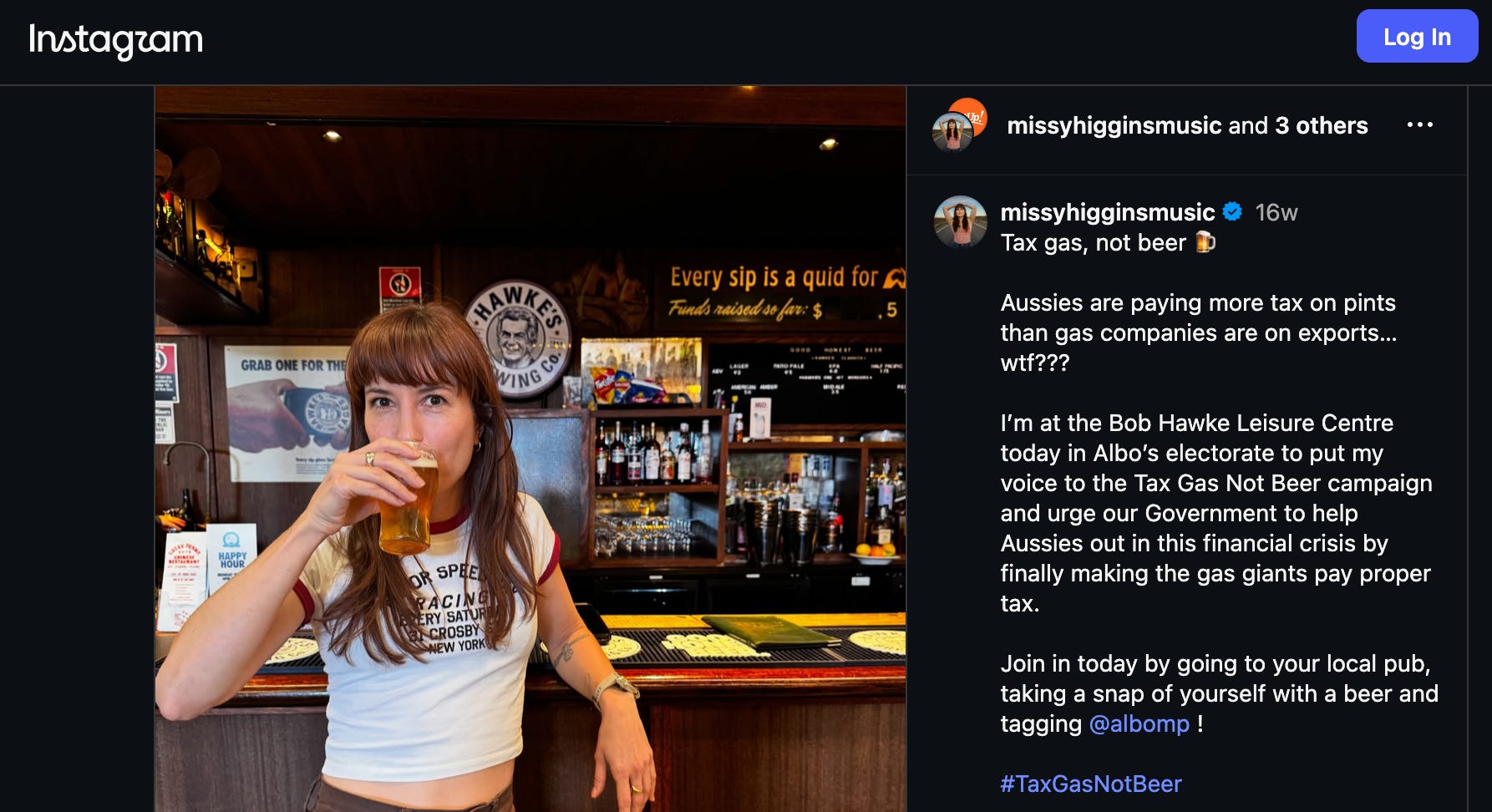
I also included, for the sake of comparative discussion, potential revenues from the hypothetical taxation of sales of legalised recreational marijuana.
From the graph below, we can clearly see the contradictory policy imperatives and failures that run counter to commonly held social and cultural values. How is it that the profit of resources companies is elevated higher than the hospitality industry, and with it, the fate of our live music culture which is dependent on the fate of live music venues? How is it that resources companies pay one quarter of the tax (PRRT) than those of us who enjoy a drink?
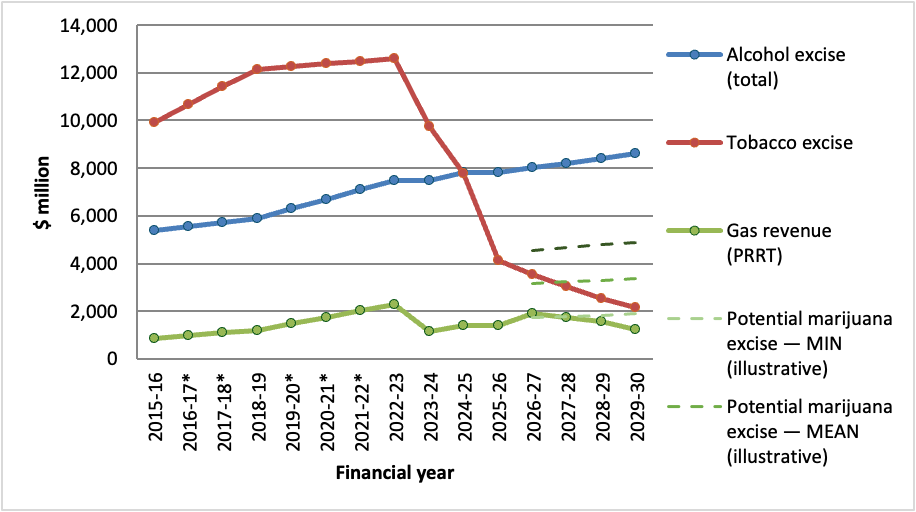
Figure 1. Comparison of revenues from Tobacco and Alcohol excise, Natural Gas Petroleum Resource Rent Tax (PRRT) and potential excise from Marijuana if Legalised (max, min, mean)
10-Year History + Official Government Excise and PRRT Forecast Horizon Only (2015-16 to 2029-30)
Australian Government cash receipts, $ million
Actual 2015-16 to 2024-25; official Budget estimates 2025-26 to 2029-30
No years beyond 2029-30 are shown — this is the full extent of the government’s own published forecasts 2026-27 to 2029-30, across three market-size scenarios (cannabis is illegal in Australia — see Read Me, note 5)
Marijuana lines are hypothetical excise illustrations, 2026-27 to 2029-30, across three market-size scenarios (cannabis is illegal in Australia — see Read Me, note 5)
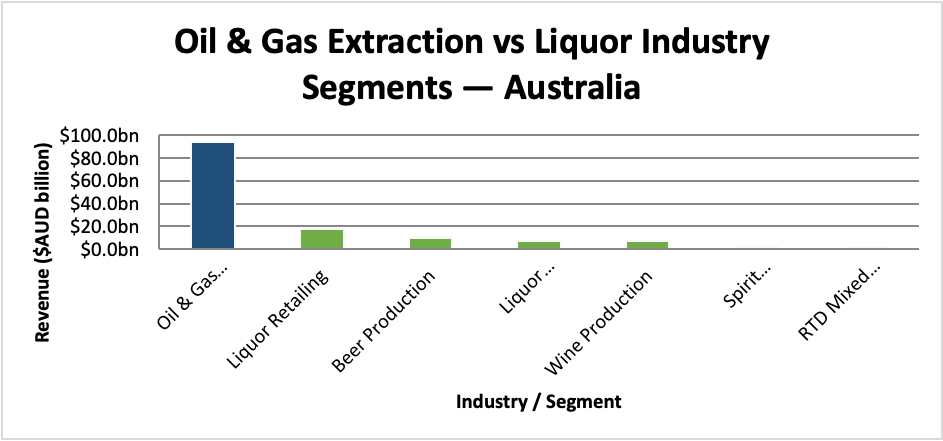
Figure 2. Oil and gas extraction (~$94.3bn) is roughly 5 times the size of liquor retailing (the biggest single liquor segment, at $18.1bn), and about 4–5 times bigger than the combined production side of the liquor industry (beer + wine + spirits manufacturing ≈ $20.4bn.
Alcohol excise is hauling in 8 billion dollars a year. Compare this to the Petroleum Resource Rent Tax, which only brings in 2 billion dollars. The paradox is that the taxes paid by each industry are the inverse of the relative sizes of the industries. Is this not outrageous?
The reason is that the fossil fuel companies get these massive offsets is that all exploration, operational, and capital expenditures are deductible, but unlike corporate income tax, where capital costs are depreciated over time, with the PRRT, this is not the case, so a resources project only pays the PRRT after it has fully recovered all eligible outlays and achieved a specific threshold rate of return on those investments. This often means new projects pay no PRRT for several years—or even decades—after production begins.
The creative cauldron of our live music scene, live music venues and festivals, get no tax breaks, yet they remain among the most taxed sectors of our economy and depend on bar sales as their main revenue stream.
“Live music venues pay more tax, levies and licensing fees than almost any other sector of the economy. These taxes include the wine equalisation tax, alcohol excise, liquor license fees, land tax, PAYG, payroll tax, council rates, health licenses, fire levies, GST, water and waste charges, and company tax. Although not a tax, live music venues and festivals are also responsible for paying OneMusic music copyright license fees”[5].
On top of this, a recent ATO tax ruling on superannuation means live music venues now also face a predicted 10-fold increase in super administration workload and the resulting compliance admin costs.
So surely, live music venues deserve some tax relief for staging our music culture night after night?
The other aspect that this graph illustrates is the amount of excise revenue foregone by the Government because their policy settings fail for both tobacco regulation and the complete lack of sensible regulation (legalisation) around the recreational use of marijuana. The government has effectively outsourced responsibility and revenue collection for these sectors to organised crime. Reading off the graph, crime bosses get an estimated fourteen to seventeen billion dollars of lost government revenue because the governments of both persuasions have neglected to correct the policy settings.
This must be one of the biggest Australian policy failures in Australian history since the introduction of the cane toad. Clearly, a rebalancing is needed. It’s a no-brainer.
So, how is this for a plan…?
First, implementing an excise rebate scheme for licensed premises (bars, hotels, restaurants, festivals) that regularly present live music. This would make a massive difference to the sustainability of the Live Music sector. The reason is simple, as the rebate goes directly into the live music organisation’s working capital, where it will be used to offset the post-COVID increase in costs of rent, insurance, wages, stock, compliance, etc. Stabilising existing venues and incentivising new hospitality businesses to stage live music will result in more playing opportunities for musicians.
Details of this proposal can be read at
https://www.counternarrative.art/p/a-better-way-for-the-federal-government.
The meagre cost of implementing an excise rebate scheme specifically for genuine live music venues would be easily offset by the three other policy corrections.
Second is to reform the Petroleum Resource Rent Tax so that it returns more than is paid by Australian beer and wine drinkers. It is outrageous that the PRRT brings in one-quarter of taxation revenues from beer, wine and spirits. By comparison, Norway receives $133 billion, compared to Australians’ $2 billion tax revenues from gas. This would easily cover the cost of a live music venue excise rebate scheme with billions left over.
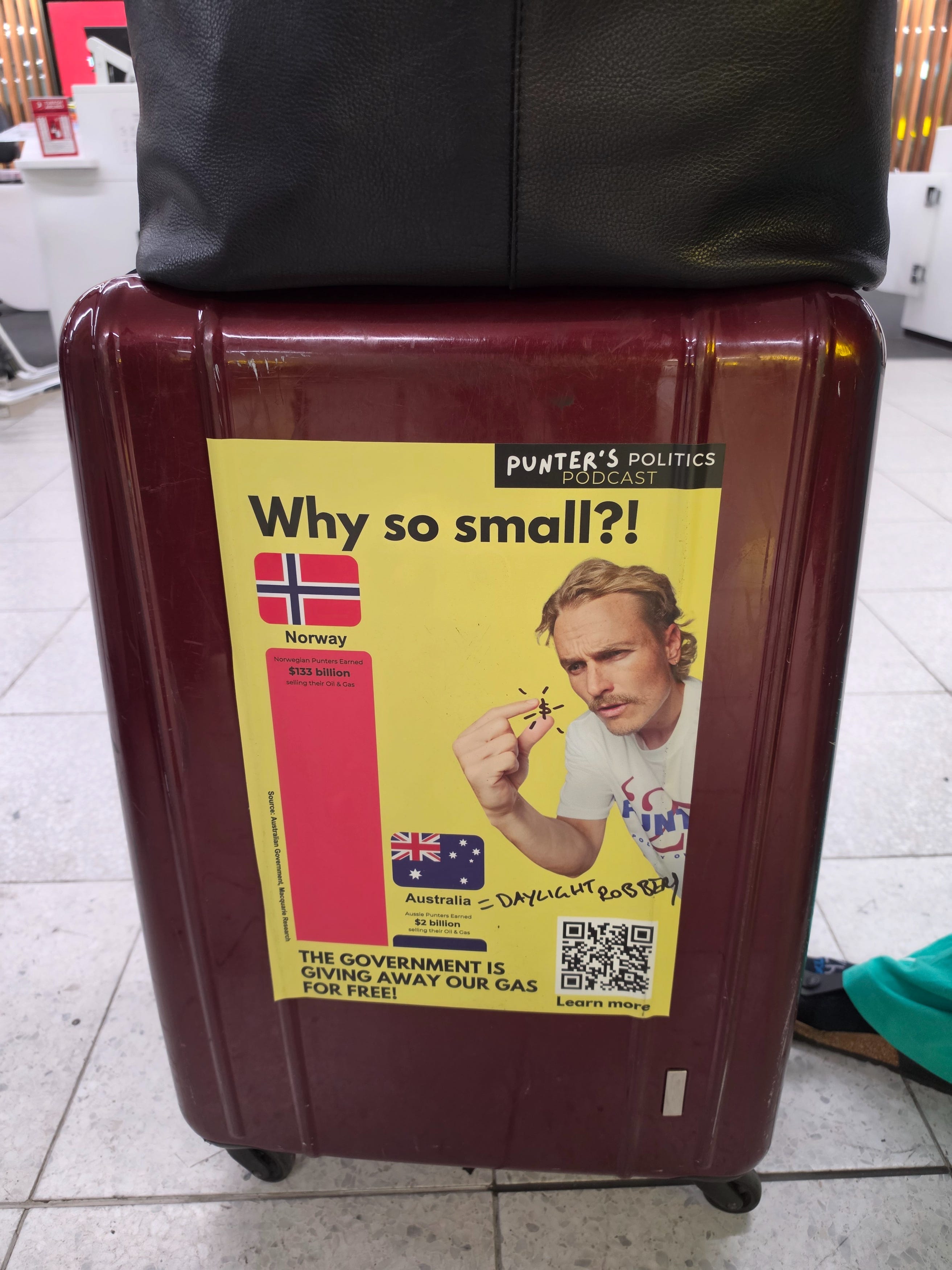
Figure 3. Photo taken at Melbourne Airport of a Nurse’s luggage on her way for a Holiday in Turkey. Punters Politics Podcast Sticker comparing Australia’s $ 2 billion in petroleum revenues to Norway’s $133 billion. Nurses pay more Tax than the gas industry.
There are several proposals for reforming the PRRT. In summary, these include:
1. Flat Gas Export Tax: Think tanks like the Australia Institute and groups like the ACTU propose a 25% flat tax on all gas exports. Proponents claim this would bypass complex deduction rules and raise billions of dollars annually.
2. Production Royalties: Some policy experts and political parties, including One Nation, advocate replacing the PRRT with a flat royalty on production or wellhead value (ranging between 10% and 30%), aligning offshore projects more closely with state-based onshore royalties.
3. Windfall Profit and Equity Models: Additional proposals include adding a windfall profit tax during extreme international price spikes to capture high global revenues, alongside government equity stakes or direct domestic gas reservation policies.
Third, reduce the excise on tobacco so that legal tobacco is competitive with the illegal products that now dominate the market. The government has completely lost control of tobacco regulation, and the Government can’t police its way back to orderly regulation. Experts and the police have said as much.
James Martin, a Deakin University criminologist who researches Australia’s illicit tobacco and nicotine markets, said,
“Policing doesn’t work against illicit markets that big and that’s because the distribution networks are dense and there’s so many players in the market that if you take one out … not just one retailer, but a whole syndicate, there are so many other competitors in the space[6].”
WA Police Commissioner Col Blanch said on ABC radio Perth,
“The organised crime business model is all about rapid resupply. If police come and do a warrant, we seize everything there or [the Department of] Health do, they’ll ring up the supplier and say ‘get the next lot down here’ and off we go again. The business model of organised crime is to resupply shops up to 10 or more times a day.[7]“
Those who still smoke are lifetime smokers. They have made the choice to move to the illegal products, not because they are better but because they are significantly cheaper and affordable. To move this welded-on cohort back to a legal product, the Government must first acknowledge the problem and shift the retail price point of tobacco to something actually affordable for the average person to win back smokers. This is necessary to stabilise the situation so effective tobacco policy can be reimplemented and the excise revenues reclaimed from the crime syndicates.
In a split with longstanding bipartisan policy, the Coalition’s Angus Taylor and Matt Canavan just announced (3rd September 2026) that they would reduce tobacco excise by 80%. Whether this is out of political expediency to better the One Nation promise to reduce excise by 75% or as Liberal opposition leader Angus Taylor said,
“You don’t bring organised crime to its knees by protecting its business model. You have to destroy the business model, and that’s what the Coalition’s policy will do.” [8]
Australian Medical Association president Danielle McMullen’s concern for “sensitive groups such as young people and people experiencing socioeconomic disadvantage, widening health inequities”[9] although well intentioned and founded in positive health outcomes, the AMA just sounds like delusional, feckless bleating because the policy leavers have been hijacked by organised crime, who obviously have no concern for such people. Their interest is tax-free money, not health outcomes. That’s the reality of the status quo.
So rebalancing excise rates isn’t just about effective health policy and tax revenues; it’s also about Australian sovereignty and the rule of law functioning.
Fourth and finally, legalise recreational marijuana use, as has been done in much of the world.
Canada, the United States, Uruguay, Germany, Malta, Luxembourg, South Africa, Georgia, the Czech Republic, the Netherlands, Spain and, in Australia – the ACT - have all legalised, to varying degrees, the recreational use of marijuana.
Why this has been resisted in Australia speaks volumes about the political cowardice of the major Australian political parties, as there are no good reasons to continue the failed policy of prohibition, which the continuation of only enriches organised crime. With 58.6% of Australians supporting no action taken for possession or a caution or warning and 45% supporting full legalisation of cannabis[10], why wouldn’t a savvy political party seeking government or re-election adopt such a popular reform policy to help distinguish itself from the insurgent right? One such party is Legalise Cannabis Victoria, who have two sitting MPs and will no doubt contest the upcoming Victoria Election in November,
What’s more, the prohibition of marijuana and other illegal drugs is a major foundation stone of structural racism. In Victoria, Aboriginal and Torres Strait Islanders are eight times more likely to be arrested for cannabis possession than non-ATSI[11]. What’s more, non-Indigenous Australians are more likely to receive a caution than be charged.
“As the recent Penington report Cannabis in Australia1 bluntly sums up, current policing of cannabis prohibition dramatically re-enforces the marginalisation of and systemic racism against Australia’s Indigenous population. In Victoria, Aboriginal Australians are charged with cannabis possession at a rate eight times higher compared to non-Aboriginal people. How, I ask rhetorically, can we ever hope to seriously redress the systemic prejudice confronted by our Indigenous communities while such laws remain on our statute books?”
Tony Parsons, retired Supervising Magistrate of the Drug Division of the Magistrates Court of Victoria.
By legalising cannabis possession and regulating its sale and distribution, State and Federal Governments would also be striking a blow to state-sponsored racism by removing a major tool for Indigenous incarceration from the justice system.
Considering Pillar One of the National Cultural Policy - First Nations First, it’s hard to fathom the contradictions between cultural and drug policies. With the over policing of music festivals, particularly in NSW, Indigenous artists and audiences justifiably feel apprehensive about participating in and attending music festivals.
However, I digress.
Is there an opportunity here for logical drug reform to also help save live music?
Perhaps there is. If a similar model of licensing was applied to the selling of marijuana for recreational use as is used for licensing liquor sales, on-premises businesses such as bars, hotels and, importantly, licensed live music venues could then sell marijuana under license to their clientele, many of whom no doubt already smoke the contraband. This would be a win-win with live music venues and festivals getting a new much-needed additional revenue stream whilst implementing the government’s hypothetical and enlightened licensing scheme for recreational marijuana consumption in a safe and experienced regulated venue.
Not only would this be good for the venue and the punter, but it could also net two to six billion dollars to the government’s coffers whilst also being a massive boost to the local reggae scene as well as the political party’s popularity, that is smart enough to adopt such a policy. Then, some of this money could be spent on the arts.
The opposition to these sensible reforms would be loud from the performative righteous wowser warriors, the powerful resources sector lobbyists and the health lobby, as it would overturn decades of belief, now obviously discredited, that increasing the price of alcohol and tobacco, sin taxes, would result in a decrease in consumption.
We don’t live in a puritanical society. Most people (yes, voters) actually like having a social beer, a glass of wine, or an occasional joint, particularly when music is in the mix. Hopefully, I’ve demonstrated that an imbalance in excise taxation and outright prohibition of recreational drugs both levies social and cultural harm to our society that outweighs the original intended but compromised good of the current policy settings. We risk losing our musical culture and much more by staying on the current policy settings, so politicians do what’s sensible, be brave, and reap the electoral rewards by correcting the course.
End Notes
[1] National (APRA AMCOS)
Pre-pandemic base: over 4,000 live music venues across the nation (APRA AMCOS, March 2020).
Loss reported: 1,300+ live music venues and stages lost since the pandemic began.
Percentage cited: Most APRA AMCOS communications describe this as “one-third fewer” licensed premises — though a May 2024 APRA AMCOS parliamentary submission described the same 1,300-venue loss as a loss of over 25 per cent of venues. So the percentage attached to the same 1,300 figure has varied between roughly 25% and one-third across APRA AMCOS’s own publications — worth flagging as an inconsistency in their reporting rather than two different studies.
Implied surviving total: roughly 2,700 venues nationally, depending on which percentage you apply to the ~4,000 base.
Victoria
Two different Victorian data points exist, from different studies:
APRA AMCOS/OneMusic licence data (via Beat Magazine, reporting on Victoria’s live music sector): the number of venues holding a OneMusic licence remains 13% below pre-pandemic levels — this is a different, narrower metric than the “24% reduction” figure previously reported by ABC (which drew on an earlier APRA AMCOS release).
The 2025 Victorian Live Music Venue Audit (commissioned by Creative Victoria, delivered by Music Victoria) is more granular and recent:
Identified 2,441 live music venues across the state as of 2024/25 (this counts any venue hosting live music, however infrequently).
Of more concern: “regular presenters” — venues hosting at least one gig per week — dropped 19.4% since 2019, from 813 down to 655 venues.
Metropolitan Melbourne: 25.8% decline (i.e., “one in four” regular venues lost).
Regional Victoria: 20.7% decline.
Hardest hit: The Grampians region, down 86.2% (from 29 regular presenters to just 4). Gippsland down 47.6%.
South Australia
SA has lost 86 mid-sized live music venues since the start of the pandemic, a 27% loss (APRA AMCOS, cited in a parliamentary inquiry submission and reported by ABC).
Back-calculating from that: if 86 venues = 27% of the pre-pandemic total, the base was roughly ~319 venues pre-pandemic, falling to roughly ~233 now. APRA AMCOS’s own release did not explicitly publish the base number — this is my calculation from the loss figure and percentage they gave, so treat it as an estimate rather than a directly reported figure.
[2] https://www.theguardian.com/music/2026/aug/29/sydney-melbourne-brisbane-live-music-nightlife-crisis-venues-closed
[3] Am I Ever Gonna See You Live Again? Yes way! You bet! Oh yeah!
House of Representatives Standing Committee on Communications and the Arts
March 2025, Canberra, page xii
Recommendation 4.28
Special Entertainment Precincts should benefit from a regulatory regime more
supportive to their ongoing viability. This may include exemptions to trading
hour restrictions, concessional liquor excise rates and differentiated noise
complaint processes.
https://parlinfo.aph.gov.au/parlInfo/download/committees/reportrep/RB000566/toc_pdf/AmIEverGonnaSeeYouLiveAgain.pdf
[4] https://www.apraamcos.com.au/about/governance-policy/annual-reports/year-in-review-23
It should be noted that from the switching of APRA live performance licenses to OneMusic licenses, quite a few live music venues did not have licenses for a period of time casting doubt on the accuracy of the APRA claim that 1300 live music venues were lost. Academic and researcher Dobe Newton noted this in his research for the Melbourne Live Music Venue Audit in late 2024 in an email to Jon Perring (9th July 2026). Never the less, the point is that a significant number of live music venues have been lost and are continuing to be lost due to decline of the Australian consumer economy since the end of the COVID lockdowns.
[5] Am I Ever Gonna See You Live Again? Yes way! You bet! Oh yeah!
House of Representatives Standing Committee on Communications and the Arts
March 2025, Canberra, Jon Perring, page 20, paragraph 2.40.
[6] https://www.abc.net.au/news/2026-08-10/charting-the-rise-of-illegal-tobacco-in-australia/106941130
[7] https://www.abc.net.au/news/2026-01-21/behind-the-scenes-of-wa-s-illegal-tobacco-business-model/106252960
[8] https://www.theguardian.com/society/2026/sep/03/coalition-plan-cut-tobacco-excise-legalise-vapes-price-cigarettes-illegal-trade
[9] https://www.theguardian.com/society/2026/sep/03/coalition-plan-cut-tobacco-excise-legalise-vapes-price-cigarettes-illegal-trade
[10] https://360edge.com.au/how-many-people-use-cannabis-in-australia/
[11] “Aboriginal and Torres Strait Islanders Eight Times More Likely to be Arrested for Cannabis Possession” — media release from Legalise Cannabis Victoria MP David Ettershank, dated 15 November 2023.
Interesting the exact number is not public as the police refused Victorian Legislative Council member for the Legalise Cannabis Victoria Rachel Payes question “How many people were arrested by Victoria Police for the possession of cannabis in 2023, and between 1 January 2024 and 31 June 2024. for the equivalent breakdown for 2023-2024”.
The lame answer given by Anthony Carbines MP, Minister for Police, Minister for Crime Prevention, Minister for Racing was “Victoria Police have advised that they do not have the capacity and resources it would require to provide the level of data that has been requested within the timeframe prescribed”.
https://rachelpayne.com.au/cannabis-related-arrests/