

On the 31st October 2025, the Minister for the Environment, Steve Dimopoulos, announced two major reviews to modernise noise rules for live music and outdoor events. The regulations governing music sound emissions from indoor live music venues in (yet to be implemented) live music precincts are currently open for input from the live music industry and residents.
Stakeholders can have their say at https://engage.vic.gov.au/EPAs-live-music-precinct-noise-regulation-review.
This article is my contribution to the discussion.
Currently, for the night-time period, the EPA’s noise protocol, used for music sound measurement in conjunction with Environmental Noise Regulation under the Planning and Environment Act, specifies that for each Octave between 63Hz and 4kHz, a measurement over 15 minutes music sound emissions must not exceed the background sound by 8dB in any octave. If it does, the source is considered to be creating Unreasonable Sound. If it exceeds 20 dB in any octave, it is considered to be Aggravated Sound (https://www.epa.vic.gov.au/unreasonable-noise-guidelines/legislative-noise-framework). The difference, besides one being louder than the other, is that Unreasonable Sound requires the emitting venue to lower their live music emissions as much as practicable and affordable, to get back into compliance, whilst Aggravated Sound emissions attract heavy fines and immediate action to cease live music sound emissions at such excessive levels.
When the Agent of Change has been applied (in proposed live music precincts), the measurement must be made within a sensitive room with windows and doors closed. An alternate measurement point is often used and “may be either within or outside a noise sensitive area. It must be chosen so that the noise at the alternative assessment location is representative of the noise exposure within noise sensitive areas” (https://www.epa.vic.gov.au/measure-music-noise-alternative-assessment-locations). The reasons for using an alternative measurement point are usually related to a lack of access.
This measurement methodology used to determine Unreasonable and Aggravated Sound is highly complex, error-prone, requires expensive calibrated measurement equipment and in some situations, specialist analysis software. As such, it can’t be used by Live Music Venues to manage sound emissions at a chosen point. It is necessary for the live music venue to engage specialist acousticians to take measurements and analyse the results.
One of the important concepts outened in the Environmental Protection Act is “to determine what is (or was at a particular time) reasonably practicable in relation to the minimisation of risks of harm to human health and the environment, regard must be had to the following matters— (c) what the person concerned knows, or ought reasonably to know, about the harm or risks of harm and any ways of eliminating or reducing those risks; (e) the cost of eliminating or reducing those risks.”
Due to the complexity, accessibility of the necessary measurement equipment and analysis software required to analyse music sound emission to the current noise protocol standard, it can’t be expected that live music venue operators can “reasonably” practically satisfy their responsibilities under the act. Nor can it be regarded that the cost of music sound emission monitoring is reasonable and affordable for most indoor live music venues to manage their compliance responsibilities.
In short, live music venues are effectively flying blind and are, unfortunately, often set up to fail.
A proposed better alternative.
A methodology that is emissions-based using dB(C) measurements overcomes many of the barriers for Indoor Live Music Venues to manage their own Live Music emissions. Commonly available handheld sound measurement meters could be used to take measurements by a live music venue operator for the purposes of assessing compliance to music sound emission regulations.
If two or more measurement points of known distance from the live music venue are used where one of those points is “chosen so that the … location is representative of the noise exposure within noise sensitive areas” (Noise limit and assessment protocol for the control of noise from commercial, industrial and trade premises, and entertainment venues, EPA Publication 1826.5, September 2025).
This avoids the complexity and expense of engaging an acoustician. Accuracy is maintained as the background sound component of the measurements is cancelled out in the calculations, eliminating errors by using background sound measurements taken at different times of the night or on different days.
The following formula can be used to calculate the music component in dB (C) at the chosen point.
Formula
It is possible to estimate the music level in dB without directly knowing the background sound level, using at least two sound readings at known distances from a single music source.
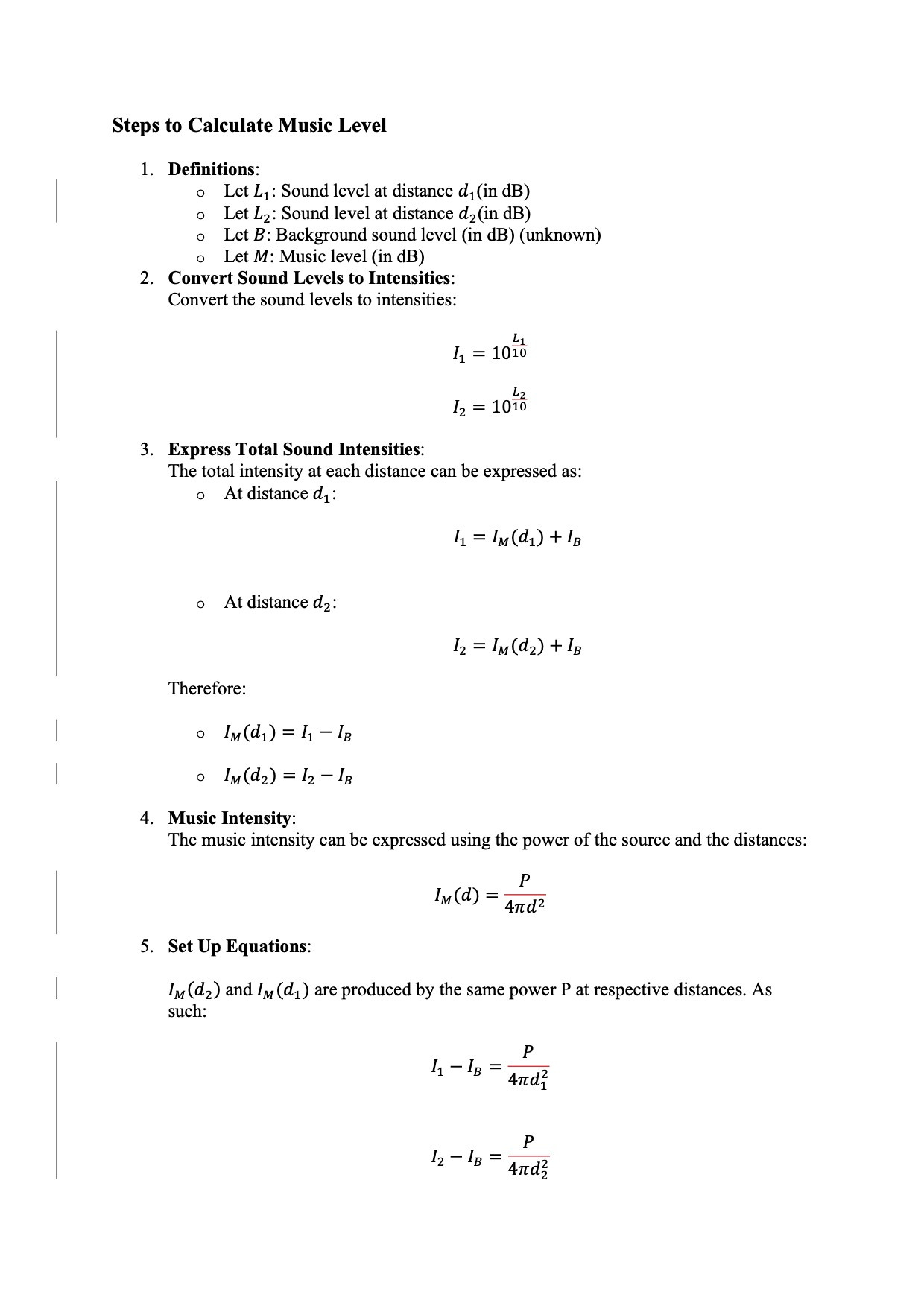
Formula summary
By following these steps, you can estimate the music level in dB based on the two sound readings at known distances, without needing to know the background sound level directly. The equations allow you to isolate the music level through the relationships between the measured intensities and distances.
Assumptions and adjustments
The current noise protocol assumes that the frequency weighting of background sound is similar to that of live music by applying 8dB headroom to each octave from 64 Hz to 4kHz. dB C measurements are flat over this frequency spectrum range. As the vast majority of amenity problems occur in the 64Hz to 250Hz region, dB (C) can be considered an appropriate measurement weighting to be used in most situations in the context of managing music sound emissions.
Difference between readings dB (C), dB (A) and LOCT90
dB (C) reads 2 dB higher than dB (A) on Pink Noise, recorded music is around 5 dB (C-A) whilst live music typically reads 8.6 dB (C-A), with a standard deviation of 2.2 dB, indicating that Live Music has a higher component of LF energy. Electronic Dance Music (EDM) would likely be greater again due to modern production techniques designed to maximise low-end potential in the music.
Both Live Music and Ambient sound have equal low-end emphasis, so no adjustments need to be made.
In such case if using dB(C) minus dB(A) readings can focus results in the sub 500Hz region of interest.
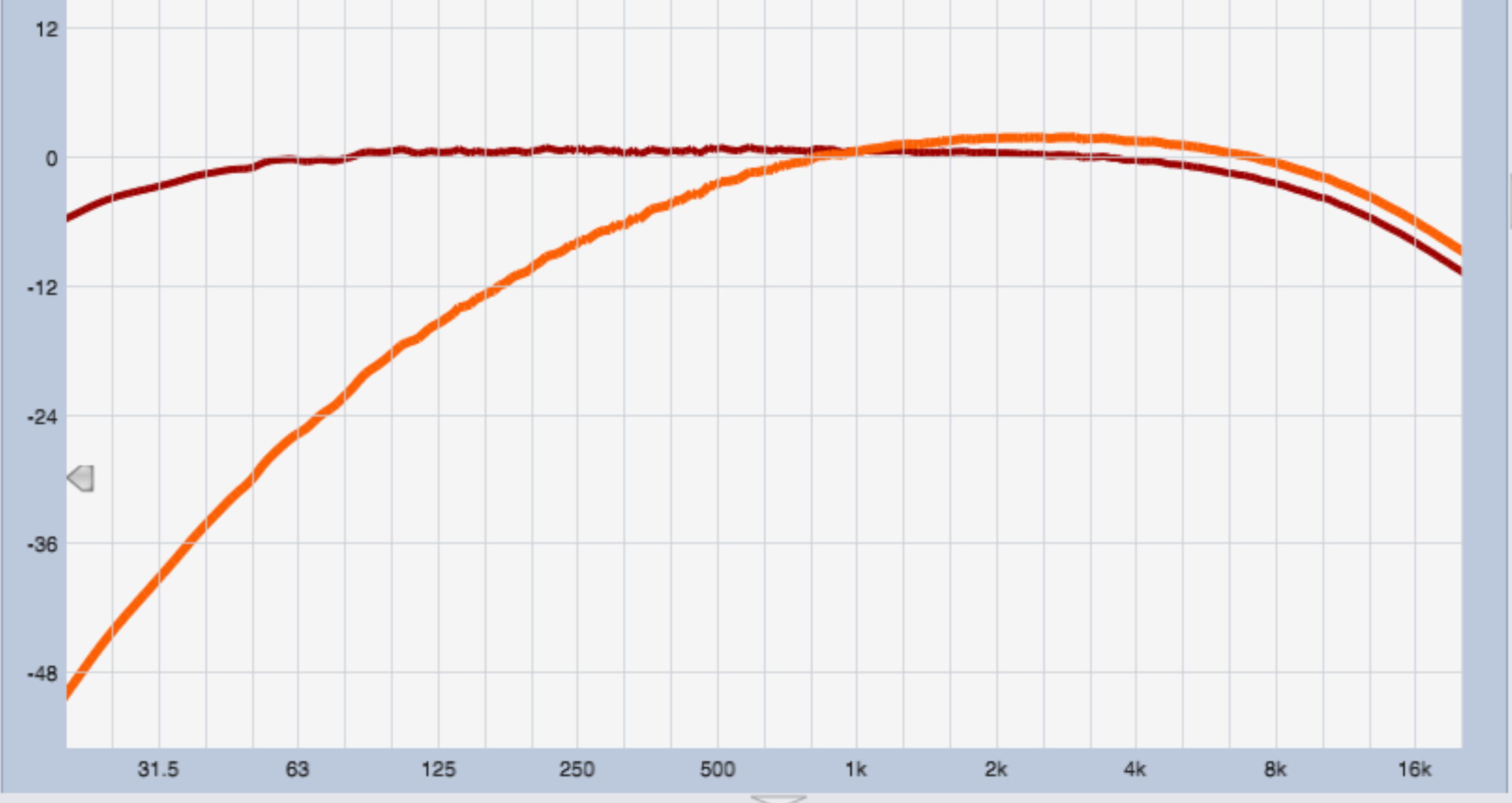
Red = C weighting
Orange = A weighting
A suggested limit
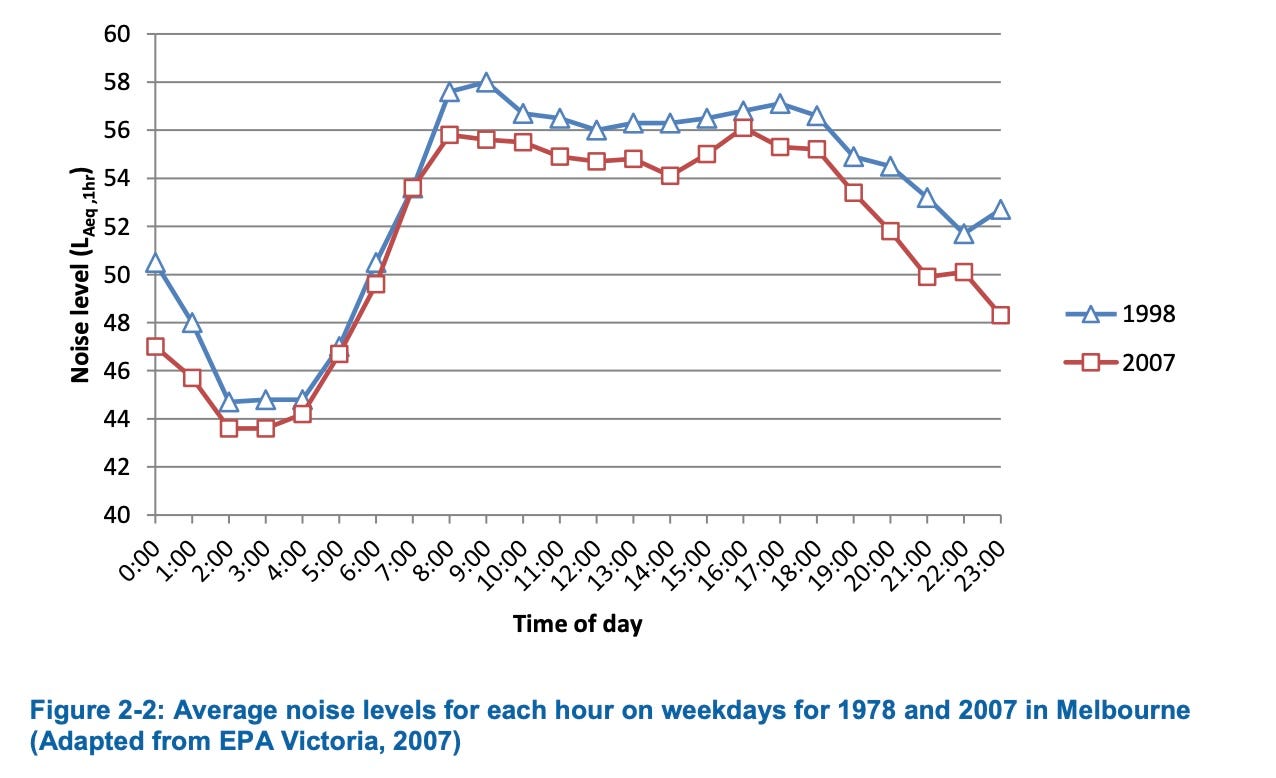
If we assume that inner-city ambient sound is typically 45dB using the Environmental Reference Standard Category II - Outdoor LAeq,8h from 10 p.m. to 6 a.m, plus 5dB for economic activity. Category II covers land uses such as Activity Centre, Commercial, Mixed-Use, and Industrial Zones, which are typical of live music venue locations in live music precincts. Other inner-city ambient sound measurements range from 52 to 55 dB (see references). If we subtract the internal noise floor of an apartment used in the noise protocol of 45 dB (s103 (b)), we can assume that the minimum level of building fabric sound attenuation is at least 5 dB without taking into account internal noise sources such as a fridge, air conditioner and mechanical ventilation. This seems low to me as its estimated that external building fabric can range from 30 to 60dB depending on construction type. Typically, single brick construction provides around 45db and double brick with a cavity provides 50dB. Such brick construction types are typical where live music precincts are likely to be located, and any residential developments constructed after the introduction of s53.06 of the Victorian Planning Provision would not be of lightweight construction (plasterboard, cladding and either timber or steel framing), which provides 30 – 40 dB attenuation.
The lack of a standard in the National Construction Code for sound attenuation for external walls in residential construction is a clear oversight that needs addressing by the government, which would lead to better amenity outcomes for future residents in areas such as activity centres and where the night-time economy is active.
Therefore, a suggested music component (excluding background sound) of the chosen measurement point should not exceed the background sound component by more than 13-15 dB directly outside a habitable room and not less than 20m in proximity. To the casual observer, this is higher than the existing 8dB in any octave, but it should be pointed out that dB(C) readings measure more energy as they cover a broader spectrum than a single octave.
However, if the weight of the measured music noise is disproportionately weighted in low frequencies, all input figures (ambient and live music sound emissions) should be used in dB(C-A). This can be determined from a raw measurement where a dB(C) measurement exceeds a dB(A) measurement by 8-10dB. This then focuses the analysis on the low-end frequency range below 1kHz.
Whatever the compliance number ends up being, it should be tested against blind listening tests in simulated scenarios against the current noise protocol. After all, the above values are very much a back-of-the-envelope calculation. It is also possible that the suggested 13-15 dB value of music sound emissions may be too low, so testing in a real-world environment is essential before final limits are decided upon.
Whatever the numeric value lands on, the above methodology is a practical and likely more accurate alternative to the current noise protocol used for the nighttime period.
I suggest implementing it as an alternative to the existing noise protocol, so that if a venue’s emissions are below the specified limit, the music venue is deemed compliant.
The existing methodology is then reserved for use in the planning context, where it excels, and in the rare cases where the alternative methodology is simply impractical to use.
Constraints on the alternate proposed methodology.
It is important to consider that the proposed alternate methodology for managing sound emissions will not necessarily work in all scenarios. For instance, if a residence abuts or is closer that 20m to a live music venue (across the road). If the residence’s habitable room is too close to or even adjoins the live music venue, the use of external measurements in such scenarios would be inappropriate. Internal sound measurements need to be used so that the entire transmission path is captured. In such situations, the current live music protocol should be used as it is a more rigorous methodology.
Some work is required to establish robust constraints for when the proposed alternative dB (C) or (C-A) sound measurement methodology is appropriate to establish a Deemed to Comply compliance status for the venue.
Finally, the scope of this paper has been in relation to indoor music venues. However, with well-thought-out constraints, the proposed methodology could also be used for outside live music events in live music precincts.
Jon Perring - 19 March 2026
References
https://www.epa.vic.gov.au/unreasonable-noise-guidelines/legislative-noise-framework
https://www.precisionaudioservices.com/blog/understanding-spl-c-minus-a
https://www.epa.vic.gov.au/environment-reference-standard
Background sound references from on-line acoustic reports
file:///Users/jon/Downloads/TP-2021-455~A-4.pdf
https://www.melbourne.vic.gov.au/dmstreamer/pr/18395648/TP-2024-29-4.pdf&ved=2ahUKEwiO28T7g4OTAxUZSWwGHSFXJEwQFnoECCMQAQ&usg=AOvVaw1mHRKA5dJy1p7HNnpSMD_k